
Cross Count 2
You’re back at the same problem, but this time the limits are high as sky.
There is a Cartesian plane with N vertical lines (infinitely long), and M line segments (finite).
Your task is to count the total number of crossings made by the finite line segments, with the infinitely long vertical lines.
Example: There are N = 4 infinitely long vertical lines, at
\[x=-5, -3,\ \ \ 2,\ \ \ 4\]There are M = 8 finite line segments:
\({(-2,\ \ \ 5),(\ \ \ 5,-6)}\)
\({(-5,-2),(-3,-5)}\)
\({(-2,\ \ \ 3),(-6,\ \ \ 1)}\)
\({(-1,-3),(\ \ \ 4,\ \ \ 2)}\)
\({(\ \ \ 2,\ \ \ 5),(\ \ \ 2,\ \ \ 1)}\)
\({(\ \ \ 4,\ \ \ 5),(\ \ \ 4,-5)}\)
\({(-2,-4),(\ \ \ 5,\ \ \ 3)}\)
\({(\ \ \ 1,\ \ \ 2),(-2,\ \ \ 1)}\)
After marking the infinitely long vertical lines and the line segments, the Cartesian plane looks like this.
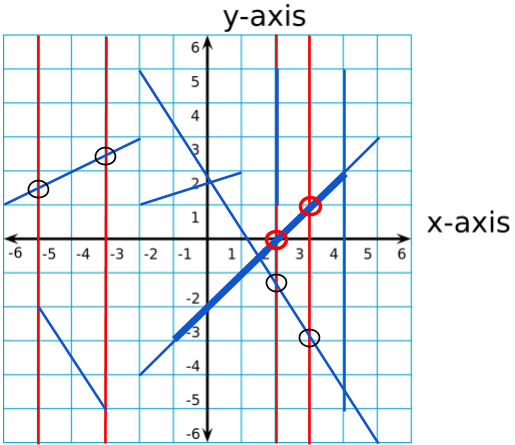
The circles denote the crossings. Black circles denote 1 crossing. Red circles denote 2 crossings. So the answer is 8.
Input Format
First line contains two integers, N and M.
Second line contains N space separated integers, with ith of them indicating Xi, the x coordinate of the ith infinitely long vertical line.
M lines follow, each containing 4 space separated integers, x1, y1, x2, y2, The start and end points of the line segments.
Output Format
A single integer, denoting the total number of crossings between the infinitely long vertical lines and the line segments.
Notes
- The output might not fit into Integer data type.
- For contestants using C++ or Java, you might need to use faster I/O techniques. (Refer: C++ / Java)
Constraints
- 1 \(\leq\) n, m \(\leq\) 106
- -1016 \(\leq\) Xi, x1, y1, x2, y2 \(\leq\) 1016
Limits
- Time Limit: 2s
- Memory Limit: 256MB
Sample Input 0
4 8
-5 -3 2 3
-2 5 5 -6
-5 -2 -3 -5
-2 3 -6 1
-1 -3 4 2
2 5 2 1
4 5 4 -5
-2 -4 5 3
1 2 -2 1
Sample Output 0
8
Open on HackerRank ↗ · Markdown source · Back to the archive