
Archive / 2022 / Final Round — Day 2
Helani's Card Game
Helani, one of your friends, came up with a new game of playing cards to play with you during the school vacation. Helani would pick 2 cards from the card-pack and you have to create a path between the two cards using the rest of the cards in the card-pack. But the problem is that each card has its own cost. Both you and Helani will play the game and while Helani tries to create a path that increases the cost, your target is to keep the cost as low as possible.
After picking the starting and ending cards, you will have to select a card from the card-pack and place it after the starting card. Then it will be Helani’s chance to pick a card. Likewise the game will continue until a path has been formed between the initially picked cards. To increase the cost, Helani will always pick the card that has the highest cost.
A pack of playing cards has 52 cards. Each card belongs to one of the following suits [1].
- Diamonds (♦) - D
- Clubs (♣) - C
- Hearts (♥) - H
- Spades (♠) - S
The face values of the cards can be denoted in the following manner.
- Ace - A
- 2 - 2
- 3 - 3
- 4 - 4
- 5 - 5
- 6 - 6
- 7 - 7
- 8 - 8
- 9 - 9
- 10 - 10
- Jack - J
- Queen - Q
- King - K
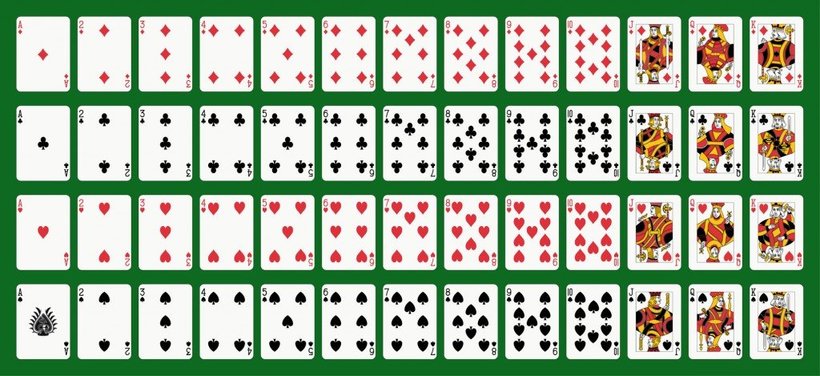
Each individual card can be identified by the letter of the suit followed by the value of the card.
Eg:
- King of Clubs - “CK”
- Ace of Diamond - “DA”
- 3 of Hearts - “H3”
- 10 of Spades - “S10”
When constructing a path, there can be only 1 change from the following 2 types of changes made to any consecutive pair of cards.
-
Increase or decrease the value by 1. Ace(A) can be used to go from a King to 2 or vice versa.
Example:- King to 2: K -> A -> 2 -> 3
- King to 10: K -> Q -> J -> 10
-
Change the current suit to 1 suit higher or lower and go in a circle in the order given above in [1].
Example:- Clubs -> Hearts -> Spades -> Diamonds
- Clubs -> Diamonds -> Spades -> Hearts
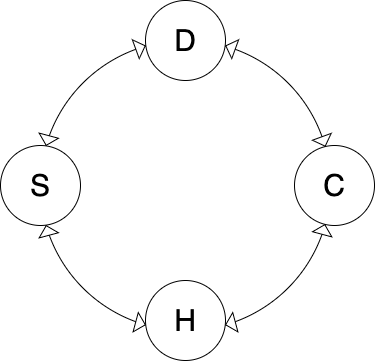
Each letter represents a suit and arrows represent to which suit you can change from your current suit.
For example, these are possible ways to go from 10 of Diamonds (D10) to 9 of Hearts (H9).
- D10 -> C10 -> H10 -> H9
- D10 -> D9 -> S9 -> H9
- D10 -> DJ -> CJ -> CQ -> HQ -> HJ -> SJ -> S10 -> S9 -> H9
Your task is to write a program to play the card game with Helani to find a path from the 2 given cards, which has the minimum cost.
If there are multiple paths with the minimum cost, the one with the minimum number of cards should be selected.
It is guaranteed that there are no multiple paths that have the minimum cost and the same no. of cards.
This is an interactive problem. You have to complete the start_game & play_turn functions given in the editor.
The function start_game receives 2 strings: start & end describing the starting and ending cards, and 4 lists: diamonds, clubs, hearts, and spades, each with 13 integers, values of the cards in that suit according to the order given above. (A, 2, 3, 4, 5, 6, 7, 8, 9, 10, J, Q, K).
The function play_turn will receive a single string card, describing the last card in the path. In the first turn, it will be the starting card. In the following turns, it will be the card picked by Helani. You have to return a string describing the next card you are selecting to build the path. If the card you returned is an invalid option, the program will exit immediately.
If the sum of the cost of the whole card pack is S, the score for each test case is calculated based on the cost of the path, using the following formula,
$ score = Min(\frac{S -\ cost\ of\ the\ path\ +\ ideal\ cost\ of\ the\ path}{S}, 1) \times 100\%$
Input Format
You should not read from the standard input, or else your solution will be considered as invalid.
The start_game function will receive a 6 arguments,
- start ( string ) - starting card of the path
- end ( string ) - ending card of the path
- diamonds ( int[] ) - values of the cards of diamonds suit
- clubs ( int[] ) - values of the cards of clubs suit
- hearts ( int[] ) - values of the cards of hearts suit
- spades ( int[] ) - values of the cards of spades suit
The play_turn function will receive a single argument,
- card ( string ) - the last card in the path
Output Format
You should not write anything to the standard output, or else your solution will be considered as invalid.
The start_game function should not return anything.
The play_turn function should return a string describing the next card for the path.
Data Types
- C++
- string -
string - int[ ] -
vector<int>
- string -
Notes
- You can learn more about functions through the following links (C/C++
Constraints
- 0 \(\leq\) cost of a card \(\leq\) 105
- 2 \(\leq\) L \(\leq\) 52 - Total length of the path
- 1 \(\leq\) C \(\leq\) 107 - Total cost of the path
Limits
- Time Limit: 1s
- Memory Limit: 256MB
Sample Input 0
D10 H9
61 74 78 62 34 83 85 66 21 1 2 6 35
56 46 99 22 95 82 58 84 25 53 43 10 38
33 57 87 80 75 37 88 77 7 11 4 3 72
100 39 23 101 67 41 42 44 8 49 9 12 85
Sample Output 0
4 67
D10 S10 H10 H9
Open on HackerRank ↗ · Markdown source · Back to the archive